The NoCodeWorkflows production system
Curation stays mine. Assembly is not my job now.
Problem
NoCodeWorkflows is my venture. It publishes operator-level reviews of no-code and AI-agent tools in a curated directory. The reviews were never the bottleneck. The assembly was the bottleneck. For each tool that I evaluated, I made a directory entry by hand: I copied links, filled structured fields, and published pages again. The directory was only as current as my appetite for data entry.
A directory that does not show my latest evaluations is not useful. I wanted the curation to stay mine, and I wanted the assembly to stop.
System
Intake is Raindrop. When I evaluate a tool, I save it and tag it there, with the same motion as a bookmark. The pipeline then does the rest of the work. An LLM synthesis step reads the saved source and drafts a structured directory entry. Each record goes into Neon, a serverless Postgres database, which holds the canonical record for each tool on the site.
The published site is static. It regenerates from the database and does not render on request. Visitors get flat, fast pages, and I keep a single queryable source of truth under them.
The line that I hold is between curation and assembly. What enters the directory, and what a review says, are my decisions. The pipeline turns those decisions into published pages.
The directory is not the only system downstream. The same save motion catches the latest news and each item worth keeping: releases, repos, papers. Those saves go into ClipBase, the knowledge base that my agents search in conversation. One intake feeds two systems. The profile “Knowing whether it improved” measures the second one.
What runs today
nocodeworkflows.co serves the directory and the playbooks from this pipeline. To publish a tool is now almost the same motion as to save it. The bookmark goes into Raindrop, and the directory regenerates with the new entry in place. The pipeline also keeps the reviews connected to real use. I write about automation tools for operators, and my own publication runs on one.
The artifact
The panels trace one tool from end to end. A bookmark is on one end, and a published page is on the other. No manual step is between them.
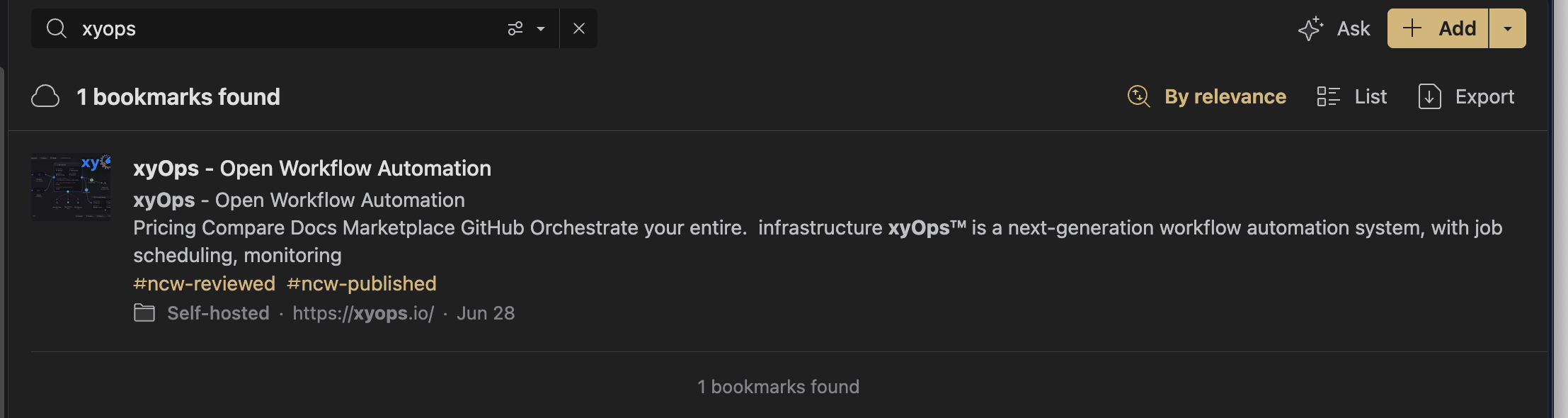
The human decision is in the tags. The tags #ncw-reviewed and #ncw-published admit the tool to the directory. Each step after this panel is the pipeline’s work.
$ psql $DATABASE_URL -x -c "SELECT slug, name, left(headline, 72) AS headline, status, icon_url, updated_at FROM tools WHERE slug = 'xyops';"-[ RECORD 1 ]------------------------------------------------------------------------slug | xyopsname | xyOpsheadline | A free, BSD-licensed workflow automation system you self-host — a visualstatus | publishedicon_url | /assets/tools/xyops/icon.pngupdated_at | 2026-08-04 13:43:30.403
This is the canonical record. The synthesis step drafted it from the saved source. The highlighted headline is the thread. Find the same headline in the next panel.
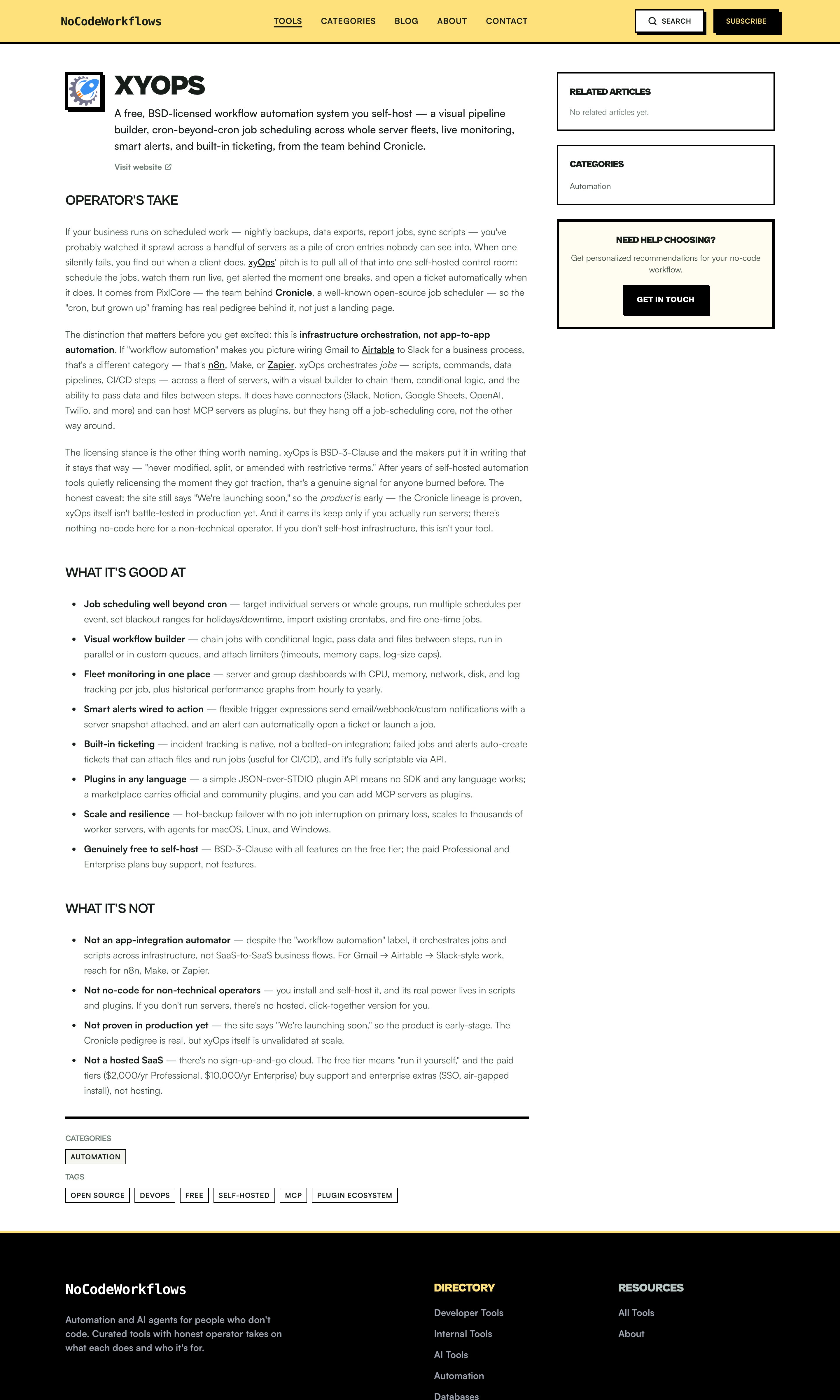
This is the published page, regenerated from the row above. The headline arrives verbatim. No manual step exists between this panel and the first.
I captured these panels live on 2026-08-13: the Raindrop card, a psql query against the production database, and the live page. The connection details are out of frame.